
Get 3 vetted & insured Maine roofers. What's your project?
The roofing contractor with the lowest number is often the one planning to leave the old roof on, reuse the old flashing and run the ice and water membrane only as far as code forces them to.
We match you with three vetted roofing contractors who quote the whole roof, deck to ridge. Our service is free for homeowners.
- 100% free for homeowners
- Same-day response before 5pm
- 10-step contractor vetting
Where winters are long, a roof usually fails at its bottom edge first. Meltwater refreezes at the cold overhang, backs up under the shingles, and finds any spot where the ice and water membrane stops short or the old flashing was reused.
The lowest roof quote is often the one that skips the work nobody sees from the yard: the tear-off, the soft decking, new flashing at walls and chimneys, and ventilation that actually moves air. Ask every bidder to price those items line by line.
Roofers carry no state license where we work, which makes insurance and track record the things worth checking. Our ten-step screening covers both before we introduce three roofing contractors to quote your roof, and homeowners pay nothing for the introduction.
How do you hire a roofing contractor safely?
You hire a roofing contractor safely by making the three quotes comparable and the paperwork airtight.
- Ask whether the old roof is coming off, and what happens when they find soft decking. A good quote names a price per sheet up front, so a surprise on day one never turns into a negotiation with your roof open.
- Make all three quotes price the same roof. Line them up on membrane coverage, new versus reused flashing, ventilation, drip edge and disposal, then confirm each roofer's insurance yourself with a certificate sent straight from the agent and read the dates.
- Get it in writing and watch the deposit. Across most of our service area, state law requires a written contract on any job over $3,000 in labor and materials and caps the initial down payment at one-third of the contract price; the Attorney General's consumer office publishes a free model contract.
How much does a roof cost?
A new roof costs about $6.00 to $16.00 per square foot of roof surface, set mostly by the material you choose and how cut up the roof is.
Roofers price by the square, which is 100 square feet of roof. Measure the roof, not the house: pitch and overhangs can make a steep roof over a small footprint bigger than a shallow roof over a large one.
| Roof | Per square foot of roof | Per square (100 sq ft) |
|---|---|---|
| Architectural asphalt, one layer off, simple gable | $6.00 – $7.50 | $600 – $750 |
| Asphalt on a cut-up roof (dormers, valleys, 8:12 or steeper) or two layers off | $7.50 – $9.50 | $750 – $950 |
| Exposed-fastener metal panel | $8.50 – $11.00 | $850 – $1,100 |
| Standing seam metal | $11.00 – $16.00 | $1,100 – $1,600 |
On an average-size house roof here, about 1,650 square feet or 16.5 squares, a simple asphalt tear-off lands around $9,900 to $12,400. Standing seam on that same roof runs about $18,200 to $26,400.
Each band is an average built from many real estimates, so read it as a planning range rather than a price. Your roof will come in somewhat above or below it.
What moves a roof inside its band is mostly what nobody can see from the ground: how much decking turns out soft, how many layers come off, and whether the chimney needs new flashing cut into the brick. Skylights, rafter repairs and ventilation changes are priced on top.
Other work our contractors do
Where do our roofing contractors work?
We take roofing requests from every town in our service area and match each one with roofers who already work nearby.
Where the house sits changes the roof. Near the water, wind-driven rain and salt air go after edge metal and fasteners, so corrosion-resistant nails and a drip edge that is locked down matter more.
Inland and on higher ground, the snow gets deeper and the cold lasts longer. There the weight of the job shifts to snow load and ice-dam protection.
- Portland, ME
- South Portland, ME
- Scarborough, ME
- Freeport, ME
- Biddeford, ME
- Sanford, ME
- Saco, ME
- Westbrook, ME
- Kennebunk, ME
- Windham, ME
- Gorham, ME
- York, ME
- Falmouth, ME
- Wells, ME
- Standish, ME
- Kittery, ME
- Cape Elizabeth, ME
- Old Orchard Beach, ME
- Augusta, ME
- Belgrade, ME
- Bangor, ME
- Lewiston, ME
- Auburn, ME
- Sidney, ME
- Waterville, ME
- Skowhegan, ME
- Conway, NH
- Rochester, NH
- Dover, NH
- Portsmouth, NH
What does a cheap roof quote usually leave out?
A cheap roof quote usually leaves out the work under the shingles, because that is the part nobody can check from the driveway.
Most homeowners compare roof quotes by shingle brand and color. What actually keeps a ceiling dry through a February thaw is everything the shingles cover.
Here is what tends to go missing from the low number:
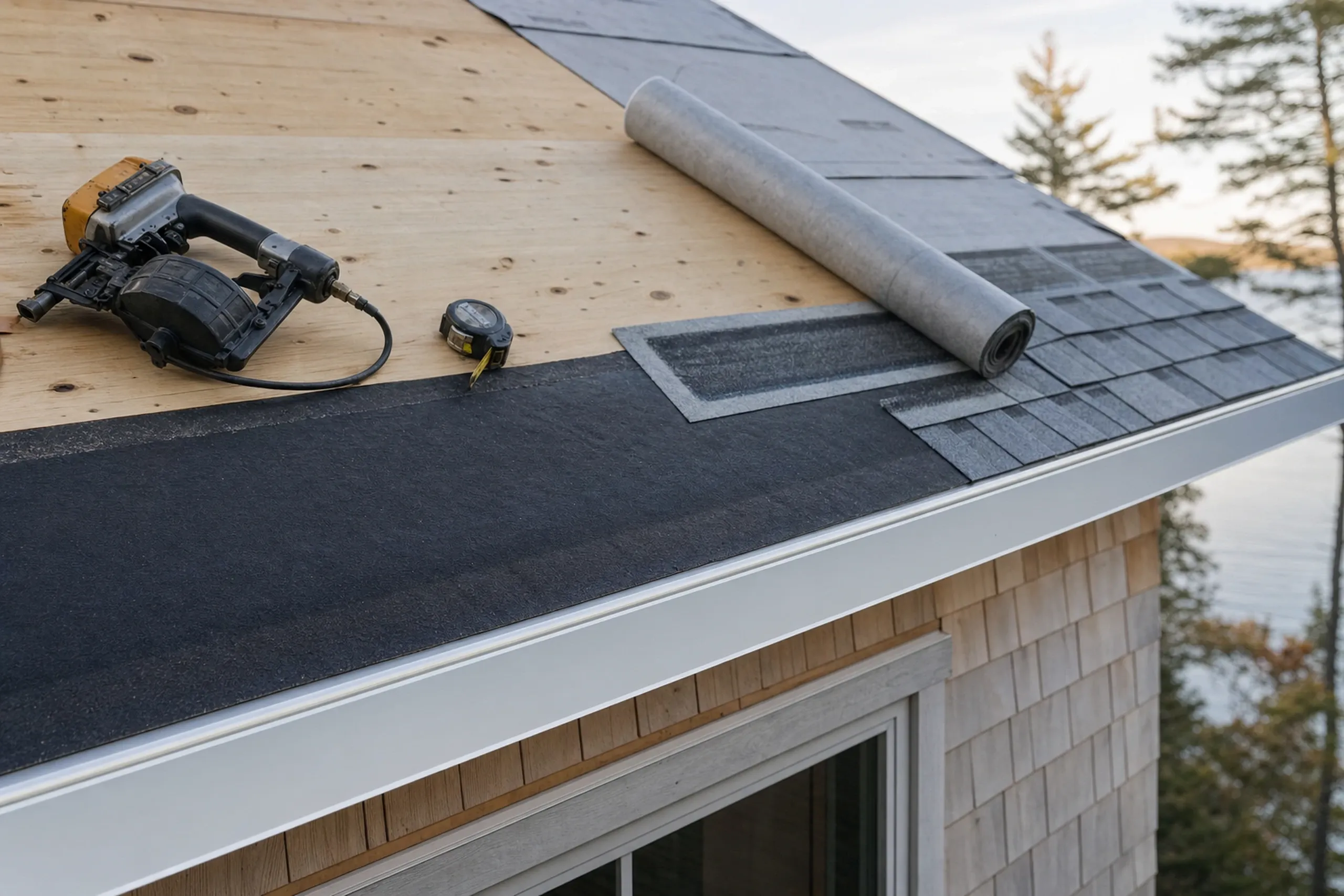
The tear-off and the deck. Laying new shingles over the old layer saves a day of labor and a dumpster. It also means nobody looks at the decking, and soft or rotted sheathing is common on older roofs once the shingles come off.
The membrane at the eaves. Code calls for an ice barrier from the eave to at least 24 inches inside the exterior wall. A bare-minimum crew stops at that line, while a careful one also runs membrane up the valleys, around the chimney and across any low-pitch section.
New flashing and real ventilation. Most roof leaks start at the step flashing along a sidewall or the metal around a chimney, and reusing those pieces is the quietest corner a crew can cut. A ridge vent over blocked soffits moves almost no air, so the attic stays warm and the ice dam builds anyway.
The first question to ask about a roof quote isn't the shingle. Ask: is the old roof coming off, and how far up from the eave does the membrane go?
A roofing contractor who answers both on the spot, and writes a price per sheet of replacement decking into the quote, is pricing the real roof.
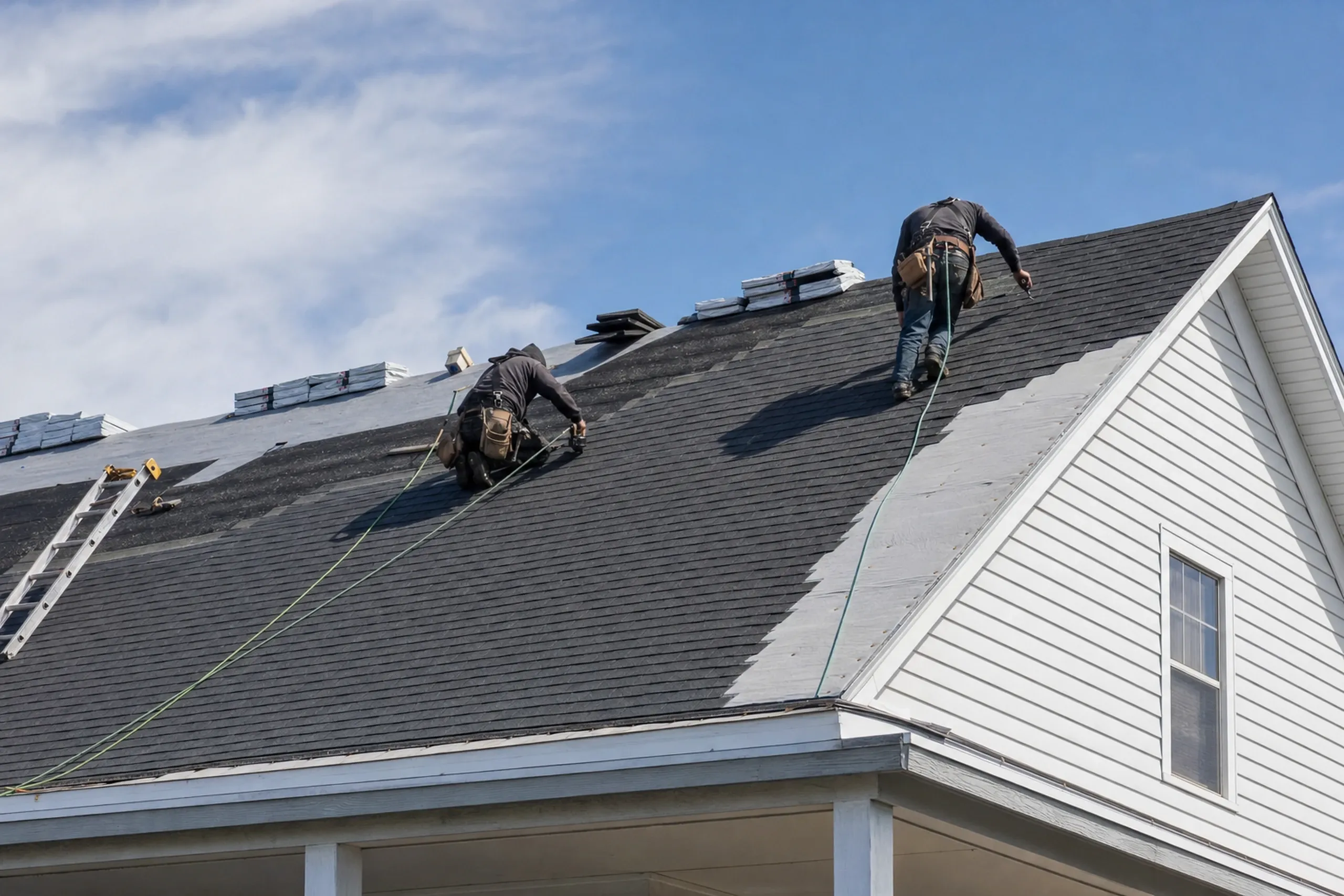
Roofing requests tend to fall into three groups.
Something is already leaking. A brown ring on the ceiling after a thaw, a drip beside the chimney, or shingles in the yard after a wind storm. A winter leak is usually an ice dam, and the fix is partly on the roof and partly in the attic.
The roof is worn out. The shingles curl at the edges, granules wash into the gutters, and the patches have started to pile up. Past that point, each new repair buys less time than the last one did.
Something else is about to change the house. New siding, an addition or solar panels all meet the roof somewhere. Replacing an aging roof before panels go up saves paying a crew to take them down and put them back later.
A full roofing project includes tearing the old roof off to the deck, replacing any soft sheathing, and building the roof back up in layers.
Those layers run in order: drip edge, ice and water membrane at the eaves and valleys, underlayment over the rest, new flashing, ventilation, then the shingles or metal. Disposal and a magnet sweep of the yard for nails belong in the price too.
Three materials cover nearly every house roof in a snowy climate:
Architectural asphalt shingles. The default, and for most houses the right answer. They cost the least up front, nearly every crew installs them well, and a damaged section is easy to repair.
Exposed-fastener metal panels. Screwed-through panels sealed with rubber washers, the budget way into metal and a common sight on barns and camps. On a house, plan on checking and replacing those fasteners as the washers age.
Standing seam metal. Panels joined at raised seams with the fasteners hidden underneath. It sheds snow, handles low-pitch sections where shingles struggle, and outlasts asphalt by a long way, at close to double the price.
Our honest take: an architectural shingle roof, torn off to the deck and detailed properly at the eaves, is a better roof than a cheaply installed metal one. Standing seam earns its price on a house you plan to keep for a long time, a roof that keeps ice-damming, or a low-slope addition.
Repair or replace? One damaged slope on a roof that is otherwise sound is a repair. Curling across every slope, or a second layer already on, means a replacement, and patching that roof is paying for it twice.
The best time to replace a roof is late spring through early fall, when the deck is dry and the shingles are warm enough to seal.
Asphalt shingles bond to each other through adhesive strips that need the sun's heat to activate. In cold weather they stay loose until spring unless the crew seals each one by hand, and that is an easy step to skip.
Good roofers fill their summer calendars early. The time to collect quotes is late winter, while the snow is still sitting on the roof you plan to replace.
A leak does not wait for summer. A storm-damaged or actively leaking roof gets tarped or patched in any season, then replaced properly once the weather allows.
If new siding is also on the list, do the roof first. The sidewall flashing has to tuck behind the siding, so the order matters.
Long, snowy winters wear out a roof from the bottom edge up, because that is where ice dams form.
Heat escaping from the rooms below warms the upper roof and melts the snow sitting on it. The meltwater runs down to the cold overhang and refreezes into a ridge of ice that holds back the next round of melt.
Shingles only shed water running downhill, so the trapped water backs up underneath them. The membrane at the eave is the last thing standing between that water and the ceiling.
Ventilation helps, but most ice dams start in the attic floor. Air sealing and insulation over the top-floor ceiling keep the roof deck cold, and a roofer who brings that up is thinking about your whole house.
Snow load matters too. A heavy, wet storm puts real weight on old rafters, and sagging framing found during a tear-off should be repaired before the new roof goes on.
Freeze-thaw cycles work on every sealant joint and nail head. Flashing that depends on caulk instead of overlapping metal is the first thing to fail.
On licensing: neither state we work in licenses roofers. Plumbers and electricians hold state licenses; a roofing contractor holds none, so there is no license number to look up. What you can check is insurance, references, financial stability and reputation, and our 10-step process checks each one before a roofer joins the network.
One credential worth asking about: shingle manufacturers run their own installer programs, and their longer system warranties often require one of those installers plus the maker's matching underlayment, starter and ridge parts. Ask who registers the warranty, and get the coverage in writing.
The 10-step vetting process
company, crew size, service area, project types, capacity, pricing posture.
years in business, structure, ability to carry materials and labor, supplier payment history.
general liability and workers' comp certificates pulled and stored.
past homeowners, subs, and suppliers. Minimum three, not only the ones they pick.
Google, Facebook, BBB, local word of mouth, complaint and dispute search.
completed work, in person or in detailed photo and video.
speed of reply, clarity of writing, handling of a difficult question.
Contractor agreement signed
first projects watched closely, homeowner feedback gathered actively.
underperformers come out of the network.
What do people ask before hiring a roofing contractor?
Can new shingles go over an old roof?
New shingles can go over one old layer under most building codes, but on a house that sees real winter a tear-off is the better call. An overlay hides the deck, adds weight under the snow, and leaves no bare wood at the eaves for the ice and water membrane to bond to.
Is a metal roof worth it where winters are long?
A standing seam metal roof is worth it on a house you plan to keep, because it sheds snow, resists ice dams better than shingles and usually outlasts more than one asphalt roof. Budget for snow guards over doors and walkways, since a metal roof lets its snow go all at once.
How long does a roof replacement take?
A roof replacement on an average-size house usually takes one to three working days in asphalt. Standing seam takes longer because the panels are measured and formed for the house, and rain or wind can stretch either schedule.
Do roofing contractors need a license?
Roofing contractors do not need a state license where we work; only trades like plumbing and electrical do. That makes insurance the thing to verify, and workers' comp matters more on a roof than almost anywhere else on a job.
Does Seth's Home Pros install roofs?
Seth's Home Pros does not install roofs, because we're not a contractor. We make the introduction, and the contract is between you and the roofing contractor you choose.
Ready for three roofing quotes on the same scope?
Tell us the town, roughly how old the roof is, and whether anything is leaking right now.
Our service is free for homeowners.